
Security Camera Field of View: Lens Angles Explained
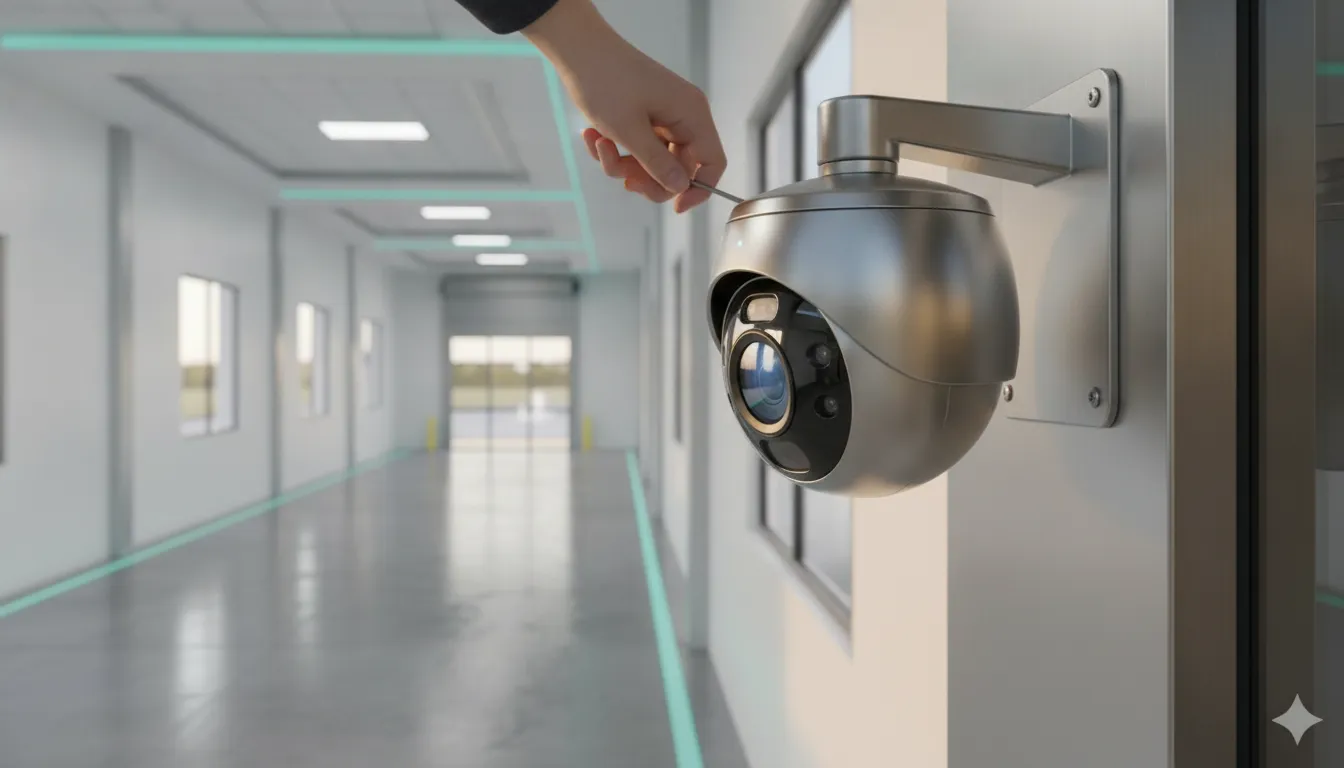
A security camera can record continuously and still miss the detail your business needs. The reason is often not the camera’s resolution. It is the security camera field of view: the portion of a scene the lens can capture at one time, at a usable level of detail.
Choosing the right view means looking at the entire scene, not just a lens specification. Entrances, corridors, cash areas, parking approaches, and production spaces all place different demands on a camera. Lens angle, mounting height, distance, lighting, and activity should work together in the design.
Request your free security assessment now
What does security camera field of view mean?
Field of view, often shortened to FOV, is the width and height of the area visible through a camera at a given distance. Manufacturers commonly describe it as a horizontal, vertical, or diagonal angle measured in degrees. A wider angle shows more of a nearby scene. A narrower angle shows less area but can place more image detail on a distant subject.
FOV is not the same as image quality. A wide view may include an entire lobby, but faces near the far end can be too small to identify. A narrow view may show a doorway in greater detail, but leave adjacent approaches outside the frame. Effective coverage is the balance between what must be seen, how far away it is, and what the footage needs to prove.
How does lens angle affect camera coverage?
The lens angle is closely related to focal length. A shorter focal length generally produces a wider view, while a longer focal length produces a narrower view. Sensor size also influences the result, so two cameras with the same focal length may not show exactly the same scene.
- Wide-angle lenses: Capture more area at short or moderate distances. They can suit small rooms, reception areas, and broad interior views, but may introduce edge distortion and make distant subjects appear smaller.
- Narrower lenses: Concentrate the scene on a specific doorway, gate, loading approach, or perimeter line. They can preserve more detail at distance, but require careful aiming.
- Varifocal lenses: Allow the installer to adjust the view during commissioning. They are useful when the final distance, subject position, or desired balance between coverage and detail needs to be confirmed on site.
Do not select a lens solely because it has the largest angle. A lens that covers everything can leave the important event too small. In the same way, a tight lens can create blind spots when the scene is active or people approach from several directions.
How do mounting height and distance change usable footage?
Mounting height changes both perspective and the amount of floor or ground visible in the image. A camera mounted too high may look over faces, especially when a person is wearing a hat or carrying an item. A camera mounted too low may be vulnerable to tampering or may capture an overly obstructed view.
Distance affects the practical field of view as well. The same lens angle covers a larger physical area as the distance increases, but the people, vehicle details, and text in that area occupy fewer pixels. This is why a camera can appear to cover a parking approach while still failing to provide useful identification at the far end.
During planning, evaluate:
- The closest and farthest point where an event may happen.
- The normal height and direction of approaching people or vehicles.
- Whether shelving, door frames, signs, equipment, or landscaping will block the view.
- Whether the camera is mounted where it can be serviced without disrupting operations.
- Where a blind spot will exist directly below or behind the camera.
A site walk is valuable because a drawing rarely reveals glare, obstructions, changing traffic paths, or the difference between a wide overview and useful detail.
How do lighting and scene activity affect field of view?
A camera’s field of view describes the scene it sees, but lighting determines how much of that scene remains usable. Bright windows behind a person can reduce facial detail. A parking approach may have strong headlights, deep shadows, or changing daylight. Reflective floors and glass can create glare that makes a wide view less effective than expected.
Scene activity matters too. In a quiet office corridor, a fixed view may be sufficient. In a busy entry, people may cross one another, open doors, or pause in several positions. A wider view can help establish what happened, while a second, tighter view may be needed for identification. The answer is often a coverage plan rather than one camera trying to perform every job.
When comparing options, review sample footage in conditions that resemble the business. Test day and night scenes, expected movement, doorway transitions, and the points where a person changes direction. A lens that looks excellent in a product demonstration may not perform the same way when aimed toward a bright exterior or a dark aisle.
Which field of view works for common business areas?
Entrances and reception areas
Entrances usually need a view that shows the approach, the door, and the interaction immediately inside. A moderately wide lens can establish context, but it should not make faces at the threshold too small. Mounting angle is important: aim to capture faces as people approach rather than only the tops of their heads as they pass under the camera.
Corridors and stairwells
Corridors are often long and narrow, so a tight view down the travel path may be more useful than an ultra-wide lens aimed across both walls. At intersections, a wider or additional camera can show cross-traffic. Stairwells require attention to landings, turns, and doors because a single straight view may leave portions of the stairs hidden.
Cash areas and point-of-sale locations
Cash areas need more than an overhead view of a counter. The design should consider faces, hands, transaction activity, and the position of the register or safe. A controlled field of view can reduce unnecessary background while preserving the detail needed for review. Coordinate camera placement with privacy requirements and the business’s operating procedures.
Parking approaches and exterior gates
Exterior views must account for distance, weather, headlights, and vehicle direction. A wide overview can show movement across a lot, while a narrower camera may be better for a gate, drive lane, or vehicle approach. If license plates or faces are an objective, specify that objective before selecting the lens and mounting point. A general parking view is not automatically a plate-capture view.
Production spaces and warehouses
Production floors and warehouse aisles often need a mix of broad situational awareness and focused views at doors, work cells, and high-value areas. Shelving and machinery can create long, narrow channels that call for a different lens than an open staging area. Use the intended review task to decide whether a camera should show movement, document a process, or preserve detail at a particular station.
When should you choose wide-angle, varifocal, panoramic, or specialized views?
Each camera type solves a different coverage problem:
- Wide-angle: A practical choice when the priority is seeing a broad nearby area with one camera. Confirm that subjects at the edges remain useful and that distortion is acceptable.
- Varifocal: A strong option when the final framing depends on a site condition that is difficult to predict before installation, or when the business wants flexibility during commissioning.
- Panoramic or 180/360-degree: Useful for large open areas where one camera can provide broad situational awareness. These views still require careful placement and may trade edge detail for coverage.
- Specialized narrow view: Appropriate for a defined target such as a gate, lane, entrance, or distant approach. It should be paired with a plan for nearby blind spots.
Many businesses benefit from a combination. A panoramic view can show how people moved through a lobby, while a focused entrance camera can preserve more facial detail. A broad warehouse view can provide context, while cameras at dock doors can document specific activity.
How can you plan the right security camera field of view?
Start with the security outcome, then work backward to the camera. A useful security camera field of view shows the right subject at enough detail for the decision you need to make, not simply the widest possible scene.
Use this process when planning coverage:
- Define the event: Decide whether the camera must detect presence, observe activity, recognize a familiar person, identify a person, read a plate, or document a process.
- Mark the target area: Note the closest and farthest target points, likely travel paths, door swings, equipment, and obstructions.
- Review lighting: Check daylight, nighttime conditions, glare, shadows, headlights, and any lighting that changes during operating hours.
- Select the view: Compare lens angles and mounting positions. Consider whether fixed, varifocal, panoramic, or specialized coverage fits the task.
- Plan overlap and blind spots: Check corners, transitions, areas behind doors, space below the mount, and points where people or vehicles change direction.
- Test the installed image: Review live and recorded footage at the times and distances that matter. Adjust framing before treating the design as complete.
Resolution is part of this process, but it cannot compensate for poor framing. Businesses comparing resolution options can also review the security camera resolution guide. For a broader planning view, see InVision Systems’ guide to business security systems with cameras.
If you want help turning these decisions into a coverage plan, explore InVision Systems’ business security camera systems in Chicago.
What should you ask before selecting a lens angle?
Use these questions during a site assessment:
- What must the footage show, and what level of detail is required?
- How far is the target from the proposed mounting point?
- Will people approach the camera straight on, from the side, or from several directions?
- What changes at night, during shift changes, or when the business is busy?
- Will one view provide context while another provides detail?
- Could a wide view create edge distortion or make the target too small?
- Could a narrow view leave a blind spot that matters to the business?
- How will the camera integrate with recording, remote access, access control, or virtual guarding?
InVision Systems designs security camera systems around the property, operating conditions, and goals of the client. The team can evaluate camera placement, lighting, lens selection, and coverage as one system rather than treating field of view as an isolated specification. Its security camera systems service covers customized solutions for commercial, industrial, and residential properties.
Schedule your free security assessment today
Frequently asked questions about security camera field of view
What is a good field of view for a security camera?
There is no single best angle for every location. Choose a view that covers the required scene while keeping the important subject large enough for the intended task. A wide view may work for nearby situational awareness, while a narrower or varifocal view may be better for a distant doorway or gate.
Is a wider security camera field of view always better?
No. A wider view can reduce the size and detail of subjects, especially near the far edge of a scene. It can also introduce distortion. Wide coverage is useful when context matters, but high-value targets may need a more focused view or a second camera.
What security cameras offer a wide field of view?
Wide-angle cameras use lens and sensor combinations designed to capture more of a nearby scene. Panoramic cameras can cover a larger area still, including 180-degree or 360-degree views in some applications. The best choice depends on the room shape, mounting location, lighting, and detail required.
How does mounting height affect camera coverage?
Mounting height changes perspective, face visibility, ground coverage, and the location of blind spots. A high camera can cover more area but may look over faces. A lower camera can improve the angle to a person but may be more exposed to tampering. Test the planned height in the actual scene.
Do business cameras need different lens angles for different areas?
Often, yes. An entrance, corridor, cash area, parking approach, and warehouse aisle have different distances, lighting, movement, and review objectives. A custom design may combine wide, focused, varifocal, panoramic, and specialized views so each camera has a defined job.
How do I choose a security camera field of view?
Define the event the camera must document, measure the target distance, review mounting and lighting conditions, and compare the expected image before final installation. A professional assessment can help balance coverage, detail, blind spots, storage, and future system needs.